Living the Values of God’s Kingdom in a Troubled World
Matthew 5:1–16
What kind of people does Indonesia need today?
It is a question worth asking as we look at what is happening around us. We hear about corruption, public dissatisfaction, social divisions, economic uncertainty, and environmental problems. We see people questioning the integrity of leaders and institutions. We also see many ordinary people struggling to build a better future for themselves and their families.
Different people may have different opinions about these situations. However, I believe there is a more important question for us as Christians: In the middle of all these circumstances, what kind of people does God want us to become?
Perhaps Indonesia does not only need better leaders, stronger institutions, or a stronger economy. It also needs people whose lives reflect honesty, compassion, justice, and peace.
This brings us to one of the most remarkable teachings of Jesus: the Sermon on the Mount.
Jesus and the Reality of a Troubled World
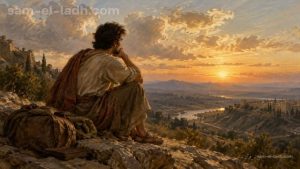
In Matthew 5, Jesus went up a mountainside, sat down, and began teaching His disciples. We know this teaching as the Sermon on the Mount.
It is important to understand the world in which Jesus delivered this sermon. His audience lived under Roman occupation. Many people experienced economic hardship, social inequality, and political oppression. They lived in a society where power and privilege were not equally shared.
They were not living in an ideal world.
Yet Jesus did not begin by explaining how to gain political influence or how to become powerful. Instead, He began by describing the character of people who belong to God’s Kingdom.
He spoke about the poor in spirit, those who mourn, the meek, those who hunger and thirst for righteousness, and the peacemakers. Then He made two remarkable statements: “You are the salt of the earth.”
“You are the light of the world.”
Notice something important. Jesus was not simply giving His followers a list of things they should do. He was describing a different kind of people. People whose values, attitudes, and actions are shaped by God’s Kingdom.
I believe this message remains deeply relevant to us today. In fact, it challenges us to consider three important characteristics of people who follow Jesus.
1. Be People Who Hunger for What Is Right
Jesus says in Matthew 5:6: “Blessed are those who hunger and thirst for righteousness, for they will be filled.”
Notice the words Jesus uses: hunger and thirst. He is not describing a casual interest in righteousness. He is describing a deep desire, something essential to life. Just as our bodies need food and water, our souls should desire what is right.
But what does righteousness mean? It is more than simply being religious, attending church, or trying to look like a good person. Righteousness means living rightly before God and seeking what is right in our relationships, decisions, and society.
When we see corruption, dishonesty, abuse of power, or injustice, it is natural to feel disappointed and angry. However, Jesus challenges us to go further.
Are we simply angry when injustice happens, or do we genuinely hunger for righteousness?
There is a difference.
It is easy to demand honesty from our leaders while practising dishonesty in our own lives. It is easy to criticise corruption while taking advantage of opportunities for personal gain. Likewise, it is easy to demand justice while treating people around us unfairly.
But people who belong to God’s Kingdom cannot live with such contradictions.
This is especially important for those of us who live in a university environment or have access to education and opportunities.
Academic dishonesty, plagiarism, manipulation of research, and using knowledge to exploit others are not merely academic problems. They are matters of character.
We cannot build a better society if we are unwilling to become better people ourselves.
The transformation of a nation must also involve the transformation of its people.
Therefore, we need people who hunger for righteousness, not only when it benefits them, but also when doing what is right comes at a personal cost.
2. Be People Who Make Peace, Not People Who Create Division
Matthew 5:9 says: “Blessed are the peacemakers, for they will be called children of God.”
I find this verse particularly relevant to our society today. We live in a world where differences can easily become divisions. Political preferences, religious backgrounds, ethnic identities, and social positions can become reasons for hostility.
Sometimes, we become so convinced that we are right that we forget how to treat people who disagree with us. We stop listening. We label people. We judge their intentions. Sometimes, we even spread hatred. However, Jesus teaches something different. He says, “Blessed are the peacemakers.”
Notice that Jesus does not say, “Blessed are those who avoid conflict.” He says, “Blessed are the peacemakers.”
There is a difference between keeping peace and making peace. Keeping peace sometimes means avoiding difficult conversations because we do not want to disturb the situation. Making peace, however, means actively working to restore relationships, overcome hostility, and build understanding.
Biblical peace is more than the absence of conflict. It is about wholeness, reconciliation, justice, and restored relationships. And here is something we must remember: Peace without justice is merely silence.
Jesus is not asking us to remain silent when people suffer or are treated unfairly. He calls us to pursue what is right without becoming people who spread hatred.
We can disagree without becoming enemies. We can stand against injustice without losing our compassion. We can defend our convictions without destroying the dignity of others.
Perhaps this is something Indonesia desperately needs today. We need people who build bridges instead of walls. People who listen instead of immediately judging. People who can disagree without hating.
As followers of Jesus, we should become agents of reconciliation. Not because we have no convictions, but because our convictions are shaped by the character of Christ.
3. Be People Who Bring Light into the Darkness
In Matthew 5:14–16, Jesus says: “You are the light of the world.”
I love the way Jesus expresses this. He does not say, “You should try to become the light of the world.” He says, “You are the light of the world.”
There is a significant difference. Jesus is declaring our identity and giving us a responsibility. But what does it mean to be the light of the world?
Think about what light does. Light exposes what is hidden. Light helps people see the way forward. Light brings hope in darkness. Most importantly, light makes a difference simply by being present.
Jesus also says that people do not light a lamp and put it under a bowl. Instead, they put it on a stand so that it gives light to everyone in the house. In other words, light is meant to shine.
Our faith is not meant to remain inside church buildings. It should be visible in the way we live, work, study, lead, and relate to others. In a society struggling with corruption, we become light through integrity. In a society struggling with indifference, we become light through compassion. In a society struggling with division, we become light through reconciliation. And in a society where vulnerable people are often overlooked, we become light by standing alongside them.
This is also where Jesus speaks about salt.
In Matthew 5:13, He says: “You are the salt of the earth.”
Salt does not exist for itself. It serves its environment. Light does not shine for itself. It illuminates what is around it. The same is true of the Church. We are not called to exist merely for our own comfort, activities, or religious communities. Instead, we are called to make a difference in the world around us.
This is particularly important for a university community. A university should not only produce intelligent people. It should also help shape people of character, integrity, compassion, and responsibility.
The question is not simply how successful we will become after graduation. The question is: What difference will our education, knowledge, profession, and influence make in the lives of others? Will we use our knowledge only to build our own future? Or will we also use it to contribute to the future of others? Will we become people who benefit from society, or people who help society become better? That is the difference between simply living in the world and becoming the salt and light of the world.
Becoming a Different Kind of People
When Jesus stood on that mountainside and taught His disciples, He was describing an entirely different way of living. A different set of values. A different understanding of success. A different kind of people.
People who hunger for righteousness. People who make peace. People who bring light into darkness. However, we must remember that Jesus did not promise that following these values would always make life easy.
In fact, Matthew 5:10 reminds us that those who are persecuted because of righteousness are also blessed. Following the values of God’s Kingdom will not always make us popular. Sometimes, doing the right thing will cost us something. Sometimes, making peace will require humility. And sometimes, bringing light will mean standing against what everyone else accepts.
But this is what it means to follow Jesus. We are not called to become like the world in order to survive the world. We are called to reflect the values of God’s Kingdom wherever God has placed us. And we do not do this simply through our own determination. We do it because we belong to Christ and are being transformed by His grace.
A Question for Indonesia, and a Question for Us
Let me bring this reflection to a close with a simple question. When people encounter us, what kind of people do they encounter? Do they encounter people who are honest? Do they encounter people who bring peace? Do they encounter people who care about those who are suffering? Do they encounter people whose presence makes a difference?
Indonesia does not only need people who complain about what is wrong. It needs people who are willing to do what is right. It does not only need people who criticise division. It needs people who build peace. It does not only need people who talk about darkness. It needs people who are willing to shine.
Jesus has already told His followers: “You are the salt of the earth.”
“You are the light of the world.”
Not tomorrow. Not when we become more successful. Not when we have more influence. But today. Wherever God has placed us.
So, here is the question I want to leave with you: Will you be that kind of people?
Not just for yourself. Not just for your family. But for your community, your nation, and the world around you.
May Indonesia encounter the love, justice, compassion, and character of Jesus through the lives of His people. Because perhaps what our nation needs most is not simply a better future, but a different kind of people who are willing to build that future.
May we be those people.
Amen.
=====
Watch the sermon on Youtube